
How to understand a glasses prescription
Understanding how a prescription is written can help with ordering the right lenses and maximizing vision benefits.

People who wear glasses may think the same prescription will work for contact lenses, but this is not true.1 Glasses sit in front of the eyes, while contacts rest directly on them. That small difference changes how light enters the eye. Check out this breakdown to read a glasses prescription like an eye care provider.
What do the prescription numbers mean?
When someone needs glasses, an eye care provider runs many tests to see how the eyes focus light. They’re trying to find the lens that helps light land exactly where it should — right on the retina.2 The retina is the screen at the back of the eye that helps to see.3 Once they find the best combination, they write down a prescription, which contains specific numbers and rules for how to make the glasses.
Here are some common parts of that code:
- OD and OS: OD means "right eye" and OS means "left eye"
- SPH (Sphere): Shows how strong the lens is for nearsightedness (–) or farsightedness (+). The higher the number, the stronger the correction.
- CYL & Axis: Shows how light bends in the eye. They are used to correct astigmatism, which is a condition where the cornea (eye lens) has an uneven curve.4
- ADD (Addition): If an older person needs help reading up close (like for bifocals or progressive lenses), they will see an ADD number. This is extra magnifying power for close-up tasks.
- PD (Pupillary Distance): The distance between your pupils. This tells the lens maker where to center the lenses. PD is especially important when ordering glasses online.
Example prescription:
OD (Right Eye): SPH -2.50, CYL -0.75, AXIS 180, ADD +1.50
OS (Left Eye): SPH -2.00, CYL -1.00, AXIS 010, ADD +1.50
This example prescription belongs to someone who has trouble seeing far away in both eyes. They also have astigmatism, which can make things look blurry or stretched. The ADD number shows they need extra help seeing things up close. Each number tells the person making the glasses how to shape the lenses so light focuses in the right spot.
(Interested in vision correction options? Some eye conditions, like astigmatism, are treatable with LASIK eye surgery. Check out this downloadable guide to learn more about the procedure.)
Still need to tap your UnitedHealthcare Vision allowance for glasses? Consider ordering them from the same convenient online location. Shop now.
What is a glasses fitting?
Whether there is a new prescription or someone is receiving glasses for the first time, a fitting makes sure the frames sit correctly on the face. An eye care provider also checks that the lenses are positioned properly to allow for the clearest vision.
A fitting may include adjustments if:
Glasses keep slipping: If glasses keep sliding down the nose, it can be annoying and make it difficult to see. An eye care provider can make the arms tighter or adjust the nose pads to keep them in place.
Glasses feel too tight: If the frames squeeze behind the ears or on the sides of the head, they can hurt or cause headaches. An adjustment can make them looser, so they feel comfortable.
Lenses aren't centered: If vision is blurry, the lenses may not be right in front of the eyes. A provider can make sure the middle of the lens lines up with the pupil.
Bent or damaged frames: Accidents happen. If glasses get bent, twisted or damaged, an eye care provider can help fix them.
Discomfort or pressure: If glasses push too hard on the nose or ears, they may need to be adjusted to feel better.
UnitedHealthcare Vision plans offer access to standard glasses lenses. Learn more today.
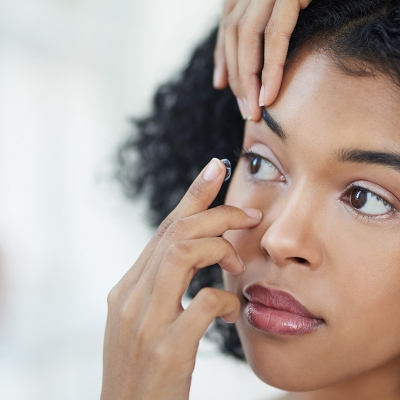
The easiest way to stock up on contacts
Find dailies, monthlies, extended wear and more, from all the top brands.
What will benefits cover?
A UnitedHealthcare Vision insurance plan usually includes:
- Routine eye exams
- Prescription eyeglasses, covered in full or by allowance
- Contact lenses, often instead of prescription eyeglasses
- Lens enhancements, like anti-reflective coating, covered in full or price protected
- Additional discounts on a range of services and products
When a person chooses an eye care provider in the UnitedHealthcare Vision Network, that helps lower their out-of-pocket costs. An in-network provider or clinic is one that has contracted with the insurance company to offer services at preset rates.
Before an eye appointment, it helps to check vision benefits. This can be done by signing in or registering at myuhcvision.com. Under “Benefits & Coverage,” simply select “Benefit Summary” to see what’s covered.
Sources
- Healthy Vision and Contact Lenses American Optometric Association.
- Eyeglasses Cleveland Clinic, March 30, 2025
- Retina Cleveland Clinic, October 3, 2024
- Astigmatism Mayo Clinic, April 30, 2025